Showing posts with label sanchona. Show all posts

Wednesday, March 05, 2008

Point of View


I finished reading Christopher Priest’s The Prestige a couple of days ago. I came across it because my son and I were having a discussion about a particular video of a quick-change-costume act that appeared on tv recently. In spite of watching several times and taking my son’s advice to not look at the two principals, but to watch away from them, I still missed seeing whatever trickery they were up to. Whatever it is they do to achieve their extraordinary quick changes, it’s superbly done.
Anyway, Ben mentioned Priest’s book because it talked about illusion and distraction in magician’s acts. But it turned out to be a lot more than that: a marvellous tale of deception and feuding between two rival magicians with some strange electricity thrown in, and quite a bit of distracting of the reader away from what the author doesn’t want you to see; well, at least not until he’s ready.
In the end the story is just a little over the top, leaning towards fantasy - and yet there are no cheap flights of fancy; it’s all told in a seemingly pragmatic way. That the events in the story are often much less than pragmatic is another thing altogether.
Priest manages four different storytellers very successfully (or is that six?), conveying the contemporary laidback attitude of the first narrator, the slightly bumptious and curiously doubled storytelling of the first magician, the background to the events told by another modern character, a woman this time, and the last long section told by the other magician – who has more than a few tricks up his sleeve, and isn’t anything like the character the other magician makes him out to be.
We get the same story more than once, and yet each re-telling peels back more layers of strangeness, showing that Priest, while not exactly leading us the garden path, is certainly not giving us all the information all the time.
Telling a story from four points of view is an achievement in itself. I know how difficult I’ve found it to successfully switch back and forth between two characters in the most recent novel I’ve been writing. (It has the working title of My Twin is Dying, but isn’t likely to finish up with that.) Priest has the advantage over me of retelling his story; I’m trying to tell a chronological story but varying who’s doing the telling as it moves along.
A friend of mine – she calls herself Sanchona on the book cover – discussed point of view at length with me (and other writers apparently) while she was writing her book A Family of Strangers. It’s one of those subtle things in writing that most new authors don’t quite see the need to deal with; great writers seem to do it without thinking.
Sometimes I think writers in discussion groups on the Net go overboard on how point of view should be achieved, and are too restrictive. Take any decent classic novel and check out how they’ve done it. I can guarantee there are as many ways of doing pov as there are of telling stories. The thing is to know what you’re doing in the first place.

Wednesday, August 15, 2007

You want Random? This is Random.

I could have called this post the Second Lesson in Writing Random Notes, because it is really a thoroughly random list of people who've appeared on my blog at some time or other, and who now come together (like strangers at a party) only because someone has searched for them and found a reference to them on my blog.
Composers, painters and writers are turning up on my HitTail reports with regularity. Gao Ping, Gareth Farr, Trevor Coleman and even Vaughan Williams amongst the composers; Karl Maugham amongst the artists, and a really mixed bunch of writers: Studdert Kennedy (Woodbine Willie), Fred Reinfield the chess writer, Anthony Berkeley Cox the mystery novelist, Colin Cotterill (who wrote The Coroner’s Lunch), James Berardinelli the film reviewer, my friend Sanchona, whose first novel A Family of Strangers is selling steadily, Winifred Kavalieris the poet, George Monibot who writes in The Guardian and Murray Grimwood who wrote in the Otago Daily Times.
Equally those two favourite subjects: fallacious arguments and athletes’ feet and fingers are having a field day, as they nearly always do. I wonder if those people who are into SEO realise just how interested people are in fallacious arguments and athletes’ feet/fingers.
And the oddball searchers turned up the following. Yoko Ono and her supposed appearance in Lost in Translation was searched for by a Norwegian user, and someone wanted to know about dockominium depreciation. The Fibonacci sequence of numbers came up; Wymondham newts; Centrum Laban, a site I mentioned in passing and about which I know next to nothing because it’s in Spanish; the pronunciation of Popadics, that young lady who is engaged to a football player; and views on the ballpoint pen by non-regular users. Hmm, I wonder what that user thought of the results?

Monday, March 12, 2007

Portmanteau Post

The HitTails program, while not giving me a large number of results, does throw up some intriguing ‘key words’ that people are supposed to have been looking up. I mentioned ‘portmanteau word’ the other day, but somehow ‘portmanteau boat’ is now a favoured search option. I’ve never heard of a portmanteau boat, and neither has Google – I’m afraid I never bother with any other search engine these days – but it sounds like an interesting concept. What would it be? Something along the lines of a yacht cum sampan?
A portmanteau, as all my readers will know (all five of you), is a large travelling bag of the sort used in 19th century novels. It was large enough to contain compartments, and thus, because it carried a variety of things, the word has come to mean the putting together of disparate objects, or even more particularly, the slotting together of two other words to make a third.
Here’s a definition of its origins from the Online Etymology Dictionary
"Travelling case or bag for clothes and other necessaries," from M.Fr. portemanteau "travelling bag," originally "court official who carried a prince's mantle" (1547), from porte, imperative of porter "to carry" + manteau "cloak." Portmanteau word, a "word blending the sound of two different words," comes from around 1882, and was coined by Lewis Carroll for the sort of words he invented for "Jabberwocky," on notion of "two meanings packed up into one word."
I’m can't quite figure what two words Jabberwocky comes from. Jabber, yes, but Wocky?
Anyway, the other major ‘key word’ was Sanchona. Now to many of you (perhaps four of the five), this is not a word with which you will be familiar. But I know it very well. Sanchona is the pseudonym of a friend of mine in Australia who has written a saga on the early days of Australian commercial history. We first ‘met’ when we were both members of an online writing group. I used to read her book chapter by chapter and comment on it. She would invariably reject my comments, but ce la vie! The book that I read hasn’t been published yet, as it was the second part of her series. But her first book is available, and is called A Family of Strangers, and I have a paperback copy. I hope it’s selling well after all the hard work she put into it, chasing agents around the world and revising and revising - and revising!

By the way, having recovered so wonderfully from my bug of Saturday, I got up to go to work this morning. By 7.15 am I was not feeling good again. And in the end I rang work and told them I wouldn't be there. Went back to bed and slept most of the morning, dreaming about finding myself at work in my pyjama trousers, amongst other things. My daughter tells me that the bug, which she has had personal experience of, does this: makes you feel great one day and lousy the next. For up to a week. Great.

Friday, December 01, 2006

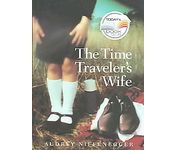
The Time Traveller’s Wife

Yesterday I finished reading The Time Traveller’s Wife, by Audrey Niffenegger. (Not an easily remembered name for an author!) It has a great idea, but it’s way too long: 518 pages. I was skimming increasingly by the last hundred pages, and in fact, had had enough by about 200 pages. Not that she’s ever dull. I just think the story would have been just as good at half the length. A lot of it isn’t plot, but an increasingly long biography of the main character, and his wife. Which is fine, but it’s too long. Did I say it was too long?

There’s an awful lot of sex, some of it described in detail, and okay, the story centres on a very intense relationship, but enough is enough already! It was a bit like my friend Sanchona’s novel, A Family of Strangers: I just couldn’t take any more of the raping and giving of the women’s bodies to men who seemed to have no self-control whatsoever. Only got through about 100 pages of that, and had had more than enough.
The problem with The TTW is that once we’ve accepted the curious idea that Henry has a chrono-displacement disorder, meaning he can suddenly vanish out of the present into either the past or the future (mostly the former), there isn’t much that happens. He can meet up with himself in the past, talk to himself, be himself at different ages and so on. And more curiously he meets up frequently with his wife to be when she’s much younger: she’s eight years younger than him, but sometimes he’s twenty or more years older than her, sometimes he’s a similar age. And along with all this time travelling we have the ongoing story of the present, which is seen through the wife’s eyes. She isn’t a TT of course. The plot is rather minimal beyond that: what really happens one morning when the wife’s family go out hunting? Did they shoot someone? In a sense we’re pretty much aware of what did happen a good way into the book, but it’s only clarified towards the end. And we have to keep checking on the dates in the book (they’re listed at the top of each short section) and see whether we’re ahead, or behind, or in the future, and how old Henry is at any particular time. It’s a nice conceit, but 500 pages of it palls.

I read some of the opinions on Epinions - some of the writers loved it, but some criticise it strongly for its sci-fi inconsistencies. They weren't things I particularly noticed, nor did I feel it was overwhelmingly drear, as one reviewer did, who pointed out all the horrible things that happen to the people in it, especially the women: madness, decapitation, five or six miscarriages to the TT's wife, and the loss of the main character's feet through frostbite. Was that really necessary?

Nevertheless, the writing is very stylish, full of lots of love for things, food, (sex), art, books, music, and relationships, and the characters are mostly well drawn. But if only it had been 300 pages, how much more intense it all would have been!
PS I see on Amazon.com there's an audio version of this book.....unabridged!