Friday, February 16, 2024

Having a forward-moving rhythm


One of the things that helped me overcome the so-called problem of Writer’s Block was an idea I found in a book wittily entitled Around the Writer’sBlock. The author is Rosanne Bane.

 As with so many books on writing, one particular thing sticks with you. Bane sees Writer’s Block as a procrastination problem. It’s dealing with procrastination that’s important.

She talks about Process Time and Product Time. Process Time is basically about play, doing something creative you wouldn’t normally do. She suggested juggling as one possibility. Since I’d tried to learn to juggle some years ago I had another go at it. This Process Time is intended to get your brain up and running before you start working. (I’m no doubt simplifying here, but it is three and a half years since I read the book.)

 Once you’ve done your allotted amount of playing, stimulating the brain into working on something that is fun, you move to Product Time. As you might expect, this is when you do the creative work on your particular project. In my case it was aiming to complete the full draft of The Counterfeit Queen, as well as making lots of notes as I went along.

 The Process should overcome your procrastination by giving your brain something fun to do. Once the brain is into that ‘play’ mood, it will be ready to do the more complex creative process of working on your product.

 It probably takes a few weeks to really settle into a routine, but I found it did work for me. Check out my original Excel file below. 

 Using an Excel sheet, I write the date on each successive line. As I work on the book each day, I make a brief note about what I've done, as well as any other relevant comments. Somehow this instils in the brain the idea that it’s good to keep moving forward each day. The amount of work isn’t necessarily important.

I used Bane's layout for some weeks before simplifying it for my own purposes. It still works well. 

 There are days when nothing gets done: I might be away from my computer and notes, as has happened over the last couple of days. Something more important than writing may come up, such as a crisis in the family. Or it may be a Sunday, when I don’t tend to work at writing. I still aim to keep the dates consistent, rather than only noting the days when work is done.

 It's surprising that a simple line reminding me of each step forward makes an ongoing difference to my sense of progress.


Tuesday, February 13, 2024

Writing at your own particular pace

At the moment my 'work in progress' opens with the collapse of a house, something that came to me while I was out walking the dog one day. The house, which hasn't collapsed, by the way, is a specific house in a specific street in my hometown. Why the house in my story collapsed remains to be discovered. I certainly don’t know at this point. 

I think it takes time for any writer to find their own approach to putting a story on paper. That doesn’t mean they don’t get books written, but gradually they discover that other people’s methods may not suit their personality. 

I remember reading years ago that the Irish writer, Joyce Cary, (a man in spite of his feminine-sounding name) would write scenes as they occurred to him. Not necessarily in any coherent order; that came later. From memory, Anne Lamott used a similar approach with her novels. 

Other writers, often known as ‘pantsers’ because they write ‘by the seat of their pants,’ just sit down and write from the beginning to the end without having any idea where the story will go. In the book, Reacher Said Nothing, Lee Child claims that’s the way his books get written. 

Young writers are often told that the way to write something as large as a novel is to structure it all out before you start, to make lots of notes about your characters so that you know all sorts of details about them – how they dress, the colour of their eyes, what they keep in their pockets and much more.   

This is rather how the film director Alfred Hitchcock worked: he wasn’t ready to film until every scene, even every shot, was set down in its place. It’s not surprising then that he sometimes said that the process of making the film itself bored him.

I can’t structure anything until I have some idea where I’m going. I understand - now - that this is my way of working, and I’m happy with it, even if it’s slow. It’s an enjoyable process of discovery. However, I don’t write the whole book before thinking about what’s already happened in the early chapters, or who the people are and how it will all end. So my first draft is already littered with comments, and there's another file altogether in which I discuss with myself what's happening. 


I can’t write about characters until I see them in action, even if the scenes that get written eventually vanish from the book. Check out these two chapters from The Disenchanted Wizard, which were deleted very early on. But they were written as though they could be used if necessary. 

I can’t imagine a whole plot in advance and then write the words that fit it. I prefer to discover things that turn up while I’m writing and then work out how everything clicks together. This is a slow process, for me, because when it comes to plotting, I’m a bear of very little brain. Nevertheless I enjoy putting my characters in difficult, even impossible, spots, and figuring out a way to get them out again. 

So, with my current work-in-progress, I’ve now written six or seven chapters. I know something about who the characters are. I know something about the places they go to, and what happens in those places. So far. I have all sorts of unexpected possible plot points turning up, unbidden, and I have the ongoing ‘fun’ of figuring out what they mean and how they’ll fit to other events. 

Hopefully it won't take another five years...


Monday, February 12, 2024

Why it took me five years to write The Counterfeit Queen

 Why it took me five years to write my most recent book, The Counterfeit Queen

 Reason 1: Procrastination.

 Reason 2: Thinking it wasn’t going to be good enough.

 Reason 3: Having to work at it completely on my own instead of with the person who’d been my idea-helper and idea-processor, plot-hole-checker, proof-reader, dismisser of unworkable or silly ideas, as well as being someone against whom I’d sometimes had to battle in order to bring storylines I wanted to include.  

 In spite of these reasons for an overlong gestation, the book got written and is now published.

 In spite of not having someone to bounce ideas against, I was still able to use that same approach when it came to working on my own. Countless words got written as notes and thoughts and possibilities, so that I acted as my own thought-bouncer, plot-hole-checker, dismisser of silly ideas, etc. In fact I was confidently able to put two drafts aside completely, each consisting of several chapters, before finding the right approach to the story.

 And the book is twice as long as my previous three children’s fantasies, to my surprise.

 Were those five years wasted? No…

 I learned that I could manage to write a book on my own, by determining to do it.

 I found that the book was good enough.

 I found that procrastination can be overcome.

More about procrastination, and my approach to writing in general - kind of pantser, but different - in future posts. 


Painting of Russian writer Evgeny Chirikov - by Ivan Kulikov 


Friday, September 15, 2023

The Counterfeit Queen is now on sale

 I've had a busy few months since I posted that The Counterfeit Queen was finished. It's now available online at Amazon, in ebook and paperback versions. Here's the blurb:

Humdrum? That barely describes Polly’s life.  

She doesn’t come on stage till the last twenty minutes of the school play, she doesn’t feel at home with her adopted parents, and she knows deep down that her life needs to be more interesting. 

Then a good-looking boy on a skateboard turns up. And explains who she really is. 

Or rather, who she should be. 

Whisked off to a place she’s never heard of, she must compete with the devious Queen Consort for something that is rightfully hers – the Throne of The Ends of the Earth. Her subjects are dwarves, halflings and humans – and a Dragon that perversely never does what it’s told. She’s confronted with fraud, deceit and danger. 

Sure, her life has suddenly become more interesting, but is she going to survive long enough to enjoy it? 

This fourth book in the Grimhilderness series reintroduces us to the heroes of Grimhilda! They’re a few years older, and hopefully wiser. And hopefully able to stand strong in the face of death.


Wednesday, April 26, 2023

Wamps and crowls

Yesterday my wife, who's from Norfolk in the UK, was talking about words she still uses that are common to people in Norfolk, but not elsewhere. One of these was wamps, another word for feet. (It's pronounced in the same way as lamps.) One might say, Get your great wamps off the table, or You're dirtying my clean floor with your muddy wamps. We tried to find the word on Google, but there was  no sign of it. 

That led to me write to David Crystal, who's produced a number of books on the English language, including at least one on dialect words from around the UK called The Disappearing Dictionary. It has that name because many of the words in the 'dictionary' are beginning to fade out of usage. 

David didn't know the word and said he'd looked it up in Joseph Wright's English Dialect Dictionary, which runs to six volumes. A digital version can be found here.  Unfortunately Mr Wright didn't include it in his book either, and now it appears the only ones who know the word are a scattering of Norfolk-born people. 

Never having come across Wright's dictionary, I clicked on the link, and, as you do, put in my name, since it's English in origin. There are two tiny towns in the UK called by that name - though their spelling is Crowle in each case. [Check out this travel blog which I wrote in 2007, and enter Crowle in the search box to find the references to it.]

We as a family had always believed that the meaning of Crowl is a curl in a river - in other words, a bend in a river. Where we picked that up from I no longer remember, but it's been the general view for many years. 

However, Mr Wright has other ideas. He claims its prime meaning is a dwarf; a stunted, deformed person or child. The word has a number of variations in the spelling, of course. 

He also claims it means to crawl, or creep. In the US it seems that a number of people mix the sound of crawl and crowl, and if you put crowl into Google, you'll get all sorts of people using the word crowl when they mean crawl, or crowling when they mean crawling. Check out this blog post on the subject. 

In a third meaning, Wright says that the plural of crowl, that is crowls, means dirt in the wrinkles of your hand. Whoever would have thought there was a word for this? 

Wright goes on to give meanings for words connected to crowl which I won't trouble you with here. You'll find them if you start with crowl in the online dictionary. 

Anyway, none of this side path stuff gives us any help with our original word, wamps. My wife is going to post on the Facebook North Norfolk site, and see if anyone else knows the word. Certainly it's well-known in her own family. 

Dwarf - or Crowl - by BrokenMachine86

Update 27.4.23. David Crystal came back to me this morning in an email saying: According to the Dictionary of British Surnames, there are two contenders for your surname's origin. One is from the Anglo-Norman surname de Crul; the other is a metathesised form of curl, 'curly-haired'. It might refer to a topographical feature, such as a river bend. ((Metathesis is the transposition of sounds or syllables in a word or of words in a sentence.)


Sunday, March 12, 2023

Out into the world The Counterfeit Queen goes

 In my last post on this (not-used-as-much-as-it-once-was) blog, I wrote about the long journey of writing The Counterfeit Queen. 

Two or three weeks ago I finished it, in the sense that I'd gone through the entire draft and rewritten and edited and cut and pasted and did all the other things you do to a new-born novel before you send it out into the world. Well, when I say I finished it, I now had before me a draft that was pretty much done. 

A friend had recently read my three earlier fantasies, the first of which, Grimhilda!, gives the background to this latest book. She had enjoyed them, though she thought the third, The Disenchanted Wizard, was the least successful of the three. Which surprised me somewhat, since my co-author and I had regarded it as our best work up to that point. And I still think it's well worth reading, having re-read it again not long ago, just to see how it stood up. 

Anyway, this friend did make some useful comments about that third book, which I took on board in regard to the current one. I asked if she'd be interested in reading the new book, knowing it might put me into deep despair if she didn't like it (!)

In fact, she loved it. I was a bit overwhelmed, to be honest. This book has been in the works for so long I was surprised anyone could love it. Although it has to be said that the book's idea has gone through umpteen transmogrifications and isn't quite the book that I'd written at least three incomplete drafts of. In other words she loved the book that all those other versions eventually became. 

So the child - the book - has been to finishing school and is now almost ready to meet the world. 

I can move forward with some confidence again. There are one or two other people who might read it and give me their feelings on it. After that, out into the world The Counterfeit Queen will go.  

Saturday, January 21, 2023

Five years on: Progress

 For something like five years I've been writing the next book in the Grimhilderness series. I've put it away, taken it out again, abandoned it, rescued it, and so on. I've had long stretches when I did nothing at all on it. 

It hasn't helped that my usual collaborator didn't like the basic idea of the book from the start, and consequently I haven't had her ideas and editorial overview for the first time since we worked together on Grimhilda! (the musical version) back in 2010-12. I'm having to do it all on my own. 

This has had its challenges, but has also allowed to me to change my mind about the direction and shape and point of view more than once. And find the best way of telling the story. 

In spite of that I had decided to give up on the project altogether last year. Sheer discouragement with what seemed to be a blank wall, and the lack of support meant I was having to find all the motivation myself. 

And then something made me drag the well and truly unfinished draft out again. It was a kind of annoyance that I'd done so much work on it and it still couldn't be brought to birth. It was a sense that I had to trust my own instincts on this one and do it anyway, even if my usual collaborator didn't like the idea. In the more distant past I'd written a good deal of at least three novels and never completed them for one reason or another, and I felt I didn't want another 'dead' one in my life.

Plus, I now have a stage musical (script and music) and four books under my belt. There was no need to regard myself as a writer who couldn't finish work. I knew I could. So, I re-read through the draft again, made more notes, did a kind of summary of each chapter and who's in it and where it takes place and much more, re-read the various outline notes I'd made to help me see where things were heading, and how I needed to bring those about. I wrote several new chapters. (This is another kids' book, so the chapters aren't long - usually around 1600-1800 words - but this is still an achievement.)

In spite of all this I had to keep on fighting to move forward, and still  have to. I look at these new chapters and think how thin and unexciting they are. But they're merely the first draft in each case. I need to remember  that the first time I tried to write the scene for Grimhilda! (the musical version) in which the toys had discussions about sending Toby off to get his parents, it was pretty awful. But two characters appeared who hadn't turned up before, and with them, and the rest of the material, it was the starting point for what was eventually an excellent scene in the show. 

My habit is to tidy up new chapters as I go along. It's helpful to get me up and running for the next day's writing. These somewhat skeletal chapters will come right in subsequent sortings-out. I've now finished the first draft, and I know how it all comes out. It's now a matter of going back and building these skinny chapters up, not just to make them interesting, but to make them fit the whole scheme of things.  It’s difficult to create much suspense when you’re not yet sure how the next stage of the book, or even the climax, will work. But once you've made your way through once, you can see the lack of tension more easily - and fix it.

Many chapters written for the previous book, The Disenchanted Wizard, got dumped completely. It’s the way I work (and I suspect a lot of writers work in a similar way) and it means that ultimately I get to the right way of telling the story. And to a book that has life. But it isn't speedy...!

I'd love to be able to sit down and write an outline without much previous thought, as some writers claim they do. And then I think of P G Wodehouse and how as he grew older he wrote longer and longer 'outlines' for his books - up to 400 pages in some cases. I can't start a book from nothing -Wodehouse could in his early days, but to keep the quality up he found he had to think the more complex plots through much more thoroughly. 

I have to get to know who the characters are, what sort of things they say and do, where the story takes place and what happens in it. And a lot of that is only discoverable by writing a draft. Just making notes doesn't cut it. Certainly there are an increasing number of notes as time goes on, and the amount of material written for the current book will exceed the final length of the book by thousands of words. Already there are two bunches of chapters that were dumped early on in the process, because they were right when the book was going in one direction, but no use when characters developed and changed and the person whom the story was really about became clear. 

Perseverance and determination. Nick Arvin, the author of Mad Boy, wrote in a tweet late last year: Writing a novel is like mowing a lawn with dull scissors while blindfolded and guided by the whispered promptings of a drunken Keebler* elf.  That's probably close enough to the truth. 


* Keebler is a biscuit (cookie) company in the US. The elves have been a part of their TV advertising for decades. 

Monday, July 04, 2022

Bringing the reader up to speed

One of my niggles that turns up again and again in cop shows on TV - the CSI type of thing - is when the detectives stand around in their office and spout exposition. I don't mean one of them telling the others what's happened, but four or more of them each telling each other what they already know. They're only doing this so the viewer knows as well.  

Character A knows exactly how much to say before character B takes over. Character B then gracefully gives in to character C who somehow knows which bit of information to supply before character D finishes the thing off. Occasionally they swap this approach around: BDCA, or the like. But it's not as if they're discussing it. Pity the poor actors trying to make this look remotely realistic.

Of course, we're not talking about real life here, but we are talking about drama. And how odd it is to find TV scriptwriters reverting to this type of exposition-giving. It was dealt the death blow in the theatre after audiences got tired of too many butlers and maids coming on stage in the first scene and cheerfully telling each other - and the audience - everything they needed to know.

Why this approach has come back into fashion in these cop dramas on TV I don't know, but it seems like lazy writing to me. Blake Snyder, in Save the Cat, talks about how exposition can be dull in a movie if you don't mix it with some action. He talks about the 'Pope in the swimming pool' - a scene in which exposition is given while the Pope is having his daily swim. The audience listens to the expository material while wondering about the fact of the Pope being in a bathing suit, or their surprise at there being a swimming pool in the Vatican in the first place. The scene gives exposition while there's visual action - even if it's mainly swimming. In Hellboy, a good deal of exposition takes place during a World War II battle. In other words, a visual event is going on while we're picking up what the story is about. 

It's necessary in novels too. No one wants to wade through a couple of characters bringing the reader up to date in an opening chapter. Inventiveness is needed. 

In my children's fantasy, The Disenchanted Wizard, a good amount of background information was given while the characters raced up the stairs and along the corridors of a mental hospital, all the while keeping an eye out for staff who might catch them being where they shouldn't be. In my current WIP, I have a helicopter playing a noisy and increasingly dangerous part as one character tells the heroine what she needs to know. They're in increasing danger of being wiped out of the sky by this very solid and noisy machine. 

Exposition can be fed to the reader in small doses over two or three chapters. If you need to bring in larger chunks of it, give the scene another element, something that keeps the reader's mind on its toes. The reader wants to know the background to the story, but will be more involved if it has to engage with other (preferably relevant) things at the same time. 


Photo courtesy of Pexels.com - one of the few sites that still offers free images that are free.

Wednesday, March 16, 2022

Odd English Words

 I've always loved odd words, and English is not only full of them now, but always has been. Sadly, a lot of the really fun-sounding words have gone into the mists of time. I used to get a regular email from World Wide Words, which the writer and etymologist, Michael Quinion, produced. Week after week, he and hundreds of his readers would add to our knowledge of the language by discussing new and old and crazy English words. Quinion no longer produces the regular emails/columns, but they're all still online here, are searchable, and fascinating to read. If you love words!

I'd like to keep the ball rolling a little by tweeting some of these words regularly under the hashtag #oddEnglishwords, and I'll reproduce the tweets here. 

16th March, 2022:

Though not a cow I have horns; Though not an ass I carry a pack-saddle; And wherever I go I leave silver behind me. The answer to this old English riddle is a hodmandod, a bumpy word we've replaced with the more prosaic 'snail.'

17th March, 2022: 

Next time a reporter tells us someone has been severely beaten in a street incident, perhaps they could use the phrase 'the victim was mammocked-up' instead.
Maybe the hospital emergency dept could adopt it too...


Sunday, February 06, 2022

Dictating text...to a computer

For some time now I've been typing up old handwritten notebooks onto the computer so that I can have a digital record of them, and clear out some more stuff from the house. These were mostly notes about my ongoing work of being a disciple of Jesus Christ, a process that not only doesn't happen as soon as you become a believer but goes on until the day you die - and maybe into eternity. Who knows?

There were also other notes amongst the spiritual stuff; sometimes these supplement material in my other journals, and sometimes they repeat the same material in a different way. 

Recently, as a result of reading an email from Dave Chesson at Kindlepreneur, I decided to save my hands a little and try and dictate the handwritten notes into the computer. I had two options: Windows Speech Recognition, which came with my computer, or Voice Typing in Google Docs. 

The Windows version produced text that was barely recognizable as what I'd dictated, and I gave up on that fairly quickly. Google does a much better job, and I'd say it gets more than 95% of the text right first time. It's the other 5% that's a bit of an issue. 

You know when you ask your phone to find something on Google, it will usually only get anything complicated right if you speak clearly, and perhaps a little slower than normal. The same applies here: go too fast, and you'll wind up with some interesting results. This means that you'll have to tidy up the text before you can copy and paste it to Word. It's still faster than typing it, but there are certain peculiarities that I can't seem to conquer. Here's are some of them. 

When I say the word, Psalm, all sorts of words appear: song, some, sound, Somme (as in the battlefield). So far Google and I can't get an agreement on this one. 

It thinks my wife Celia is actually Siri. Which seems strange, since this isn't an Apple computer. When I say the word, Dad, which I often do, since I address quite a few of the entries in these notebooks to my Heavenly Father, it often appears as Dead

Some of the quirks might be the result of my accent, a New Zealand one. I don't have a strong NZ accent, and I've lived in England and so acquired a cleaner English sound at one point, but Google always thinks I'm saying and when I say in, and vice versa: in for and. It also has a tendency to catch the word yet as it. Plainly my improved NZ accent isn't improved enough. 

Not all the errors are misinterpretations of what I'm saying. It likes to capitalize random words. I couldn't figure out why, but I wondered if it picked up certain phrases as being the names of songs, and so capitalized them as though I was mentioning the song in the middle of my sentence. While it's good at making sense of some grammatical issues, it's not so good at making sense of things it just plain doesn't understand. 

It's also is a bit hazy about capitals at the beginning of sentences. These often go missing for no good reason. 

Punctuation is a bit of a problem too. Full stops and commas, in general, are okay. Saying new line will create a new paragraph. Even semi-colon works more often than not. But colon usually appears in the text as Colin, or something similar, while the programme can have off days with comma, turning it into all manner of things: gonna, comedy, colour! I've given up trying to introduce brackets; sometimes the closing bracket will work, but not the opening one. And as far as I can tell, there's no way to tell it to put quote marks around dialogue, which means it would be a bit painful writing a novel in this way. 

It likes to introduce numbers into the text. So far the word too has never appeared (though to makes it). Too is always rendered as 2. Sometimes for appears as 4. 

As you can see, there's always a bit of cleaning up to do after it's typed out your dictation. Still, this is easier than typing up old notebooks of hastily-written paragraphs. 

But if the errors are frustrating, they can also be inventive, and sometimes hilarious. 

Womb for room was a bit of a surprise, but definitely quirky were: dressed tickly for drastically, and metre fur for metaphor. 


Sunday, January 30, 2022

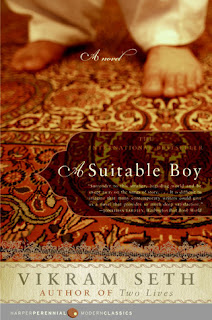
Re-reading A Suitable Boy

After nearly three decades I'm re-reading A Suitable Boy, that vast (1500 pages almost) and detailed book of life in India not long after the Partition by the British. 

It's full of stories, all interconnected, and of people from all walks of life. In the following quote, a politician, L N Argawal, has just been questioned in Parliament about a the recent shooting of several Muslim rioters: a mob of some thousand were planning to attack the foundations of a new Hindu temple that was being built right next door to a Muslim mosque. (The mosque itself had been built on the site of a Hindu temple some centuries before.) 

With typical political-speak, Argawal manages to answer very little, particularly to a Muslim female politician who is fired up about what's happened. A little later, he speaks to one of his staff:

'...a good man will not make a good politician. Just think - if you had to do a number of outrageous things, would you want the public to forget them or remember them?'
Clearly the answer was intended to be 'Forget them,' and this was the MLA's response.
'As quickly as possible?' asked L. N. Argawal.
'As quickly as possible, Minister Sahib.'
'Then the answer,' said L N Argawal, 'if you have a number of outrageous things to do is to do them simultaneously. People will scatter their complaints, not concentrate them.' When the dust settles, at least two or three out of five battles will by yours. And the public has a short memory. As for the firing in Chowk, and those dead rioters, it will all be stale news in a week.'
The MLA looked doubtful, but nodded in agreement. (page 278) 

This may seem an obvious enough piece of politicking, but it's very relevant to the state of New Zealand politics at the moment: behind all the ongoing stuff about Covid that our Prime Minister spouts each day and which seems to have all her attention, have been a number of other Bills and changes to the life of New Zealanders, some of them snuck in under the radar almost. The idea of doing enough outrageous things to dissipate the attention of the voters seems to be enacted on an almost daily basis in this country. 

I finished this back in February 2023. Some further thoughts on it:
I'm amazed at how little I remembered of it, even given that it's nearly thirty years since I last read it. One or two things were familiar, but overall, the book was completely new. Which was a delight. 
It's extraordinary in the way it encompasses practically everything in life - the rich and the poor, politics, academics, religions, weddings, births, deaths - and does it with consummate ease. Seth is able to wander down by-ways and tell stories of people who are barely part of the main plot, he is able to offer us a large range of main characters and help us keep track of them all (in fact, characters who appear chapters before and suddenly turn up again are somehow brought to mind again with ease). There are huge disasters, horrifically selfish people, wonderful, generous people, foolish people, conniving people, arrogant people, deceitful people and all the rest. There are poems and songs and religious texts; there are sub-plots that play strongly into the main storyline in due course; there is a seemingly intimate knowledge of how so many things work, from shoe-making to medical operations, just to mention two. And so many characters are so vividly drawn. 
And the whole purpose of the book is never lost: the need to find a suitable boy for the main character, Lata. Or at least that's what her mother thinks. From the first page to the last, this is a constant theme. 
What a wonderful book!


Saturday, December 11, 2021

Applying the Word

Dale Ralph Davis is one of my most read commentators, whether it's in his series stretching from Judges to Kings, or in his writings on the Psalms, or his books on other matters. I've probably read each of his books that I own two or three times. 

I was going back through an old diary this morning, and found this quotation from his commentary on 2 Kings, The Power and the Fury, page 205. As always, Davis is able to find ways to apply God's Word to our contemporary situation:

We might call ourselves evangelicals and yet there is little zeal after personal piety, little effort to teach and indoctrinate our families, not much passion to bear personal or public witness - or to raise our voice against unbelief in our church denomination. We don’t see why righteousness must be rigorous or godliness aggressive.

This is so true of my own personal Christian behaviour, and no doubt of many others who claim to follow Jesus Christ, at least in the Western world. We live in a world full of stuff, full of distraction and full of things that call us away from our centre. Yet God has placed us in this part of the world. He doesn't expect us to succumb to its lifestyle, but to make our lifestyle distinctive in the midst of it. 

Father God, help us to change, to be 'holy as You are holy.' 


Follow the science?

Next time we hear 'follow the science' or its like, it might be worth thinking about this statement:

"Science is a passionate search for always newer ways to conceive the world. Its strength lies not in the certainties it reaches but in radical awareness of the vastness of our ignorance. This awareness allows us to keep questioning our knowledge and thus to continue learning. Therefore the scientific quest for knowledge is not nourished by certainty, it is nourished by a lack of certainty."
Carlo Rovelli, in the Introduction to Anaximander.
(Rovelli is an Italian theoretical physicist and writer who has worked in Italy, the United States and, since 2000, in France. He works mainly in the field of quantum gravity and is a founder of loop quantum gravity theory. He has also worked in the history and philosophy of science.)

Photo: Jamie Stoker


Friday, November 26, 2021

The Law of Human Nature

This is another post of quotes from books I've read recently. These two occur early in C S Lewis' Mere Christianity, which I've certainly read a couple of times, if not more. It isn't always an easy book, and you wonder, when the first sections were broadcast as talks, how the listeners were able to keep up. Plainly they did, and the enthusiasm for the talks was such that they were very quickly published in the form of three separate pamphlets, and then into a single book. This book remains one of the top-selling Christian books of all time, and has been instrumental in changing the lives of many a reader. 

The law of gravity tells you what stones do if you drop them; but the Law of Human Nature tells you what human beings ought to do and do not. In other words, when you are dealing with humans, something else comes in above and beyond the actual facts. You have the facts (how men do behave) and you also have something else (how they ought to behave). In the rest of the universe there need not be anything but the facts. Electrons and molecules behave in a certain way, and certain results follow, and that may be the whole story.* But men behave in a certain way and that is not the whole story, for all the time you know that they ought to behave differently.

Notice the following point. Anyone studying Man from the outside as we study electricity or cabbages, not knowing our language and consequently not able to get any inside knowledge from us, but merely observing what we did, would never get the slightest evidence that we had this moral law. How could he? for his observations would only show what we did, and the moral law is about what we ought to do. In the same way, if there were anything above or behind the observed facts in the case of stones or the weather, we, by studying them from outside, could never hope to discover it.

A little later he says:

Do not think I am going faster than I really am. I am not yet within a hundred miles of the God of Christian theology. All I have got to is a Something which is directing the universe, and which appears in me as a law urging me to do right and making me feel responsible and uncomfortable when I do wrong. I think we have to assume it is more like a mind than it is like anything else we know—because after all the only other thing we know is matter and you can hardly imagine a bit of matter giving instructions. But, of course, it need not be very like a mind, still less like a person. In the next chapter we shall see if we can find out anything more about it. But one word of warning. There has been a great deal of soft soap talked about God for the last hundred years. That is not what I am offering. You can cut all that out.

I love that last sentence! Imagine hearing that while you were listening to the broadcast; it would make you sit up suddenly. 


Tuesday, November 23, 2021

The commonsense of ordinary people


A few weeks back I finished reading Jason Riley's biography of Thomas Sowell, entitled
Maverick. It's a great book, and full of quotable things that are especially relevant to our current times. I'm going to go back through my Kindle highlights over the next period of time, and add some of the highlights to this blog. Here's the first:

His early struggles to make a life for himself meant “daily contact with people who were neither well-educated nor particularly genteel, but who had practical wisdom far beyond what I had,” he recalls. “It gave me a lasting respect for the common sense of ordinary people, a factor routinely ignored by the intellectuals among whom I would later make my career. This was a blind spot in much of their social analysis which I did not have to contend with.”

I know some fine academics, people who are attuned to commonsense of ordinary people. But of course, we all know and hear of academics who are not! 

Tuesday, October 05, 2021

Finding ideas

As someone who writes day in and day out, I sometimes have to stop relying on the muse and resort to a more pragmatic approach to idea-finding. One possibility is to work through the 10 tips in Howard Scott’s Finding article ideas without leaving your desk.  Mr Scott listed these 10 tips way back in a 1993 Writers Magazine, and I wrote them down for a rainless day.

First, he says, ask: What if? What if I did such and such? Hmm. There used to be a columnist in New Zealand’s Sunday Star Times who wrote just such an article each week. However, he actually did the things he wrote about, setting - or having others set - often absurd challenges which he then turned into a column. But since Scott talks of finding ideas without leaving the desk, I think we can put that suggestion aside.

The second approach is to consider your latest rants. Here's this week's.  Is it surprising that our society is becoming more violent when abortion is considered 'safe' as long as the mother is okay - even though the safety of the person within is violated?

Too complex for a short blog post.

Observe an object, says Mr Scott, or a process. Don't just observe; think about it.

Well, I've sat here observing my computer screen for several minutes while my wife and son debate the rules of draughts behind me. Gritting my teeth and turning my ears off hasn't helped. The whole point of this exercise is to assist me, not frustrate me.

Next. Read news stories; pause over something that interests; what further questions or reactions? Hmm. A cellist in a European orchestra due to play Peter and the Wolf quits her job because she feels wolves are being discriminated against in the story.

This ranks alongside the ill-considered removal of a Pinocchio mural from a children's hospital wall. Adults' screwed-up notions being foisted on children who think political correctness has something to do with keeping your elbows off the table. (Whoops, this sounds more like a rant.)

Mr Scott next suggests I should find a new angle on an old article. I have enough trouble trying to find an angle on most of the ideas I do have without going through the process twice over.

I once wrote myself an enthusiastic maxim. Every idea has two outlets. Sadly, my brain has found the effort of forever conceiving twins quite unsustainable.

Next on the list. Reverse the popular notion - what if the opposite were the norm?

This is rather like lateral-thinking Edward de Bono's creative notion of using the word 'po' when you

Edward de Bono

make a statement that's norm's opposite.  'Po - planes fly upside down.' In Mr de Bono's books this approach always works - within minutes. My lips say 'Po,' however, and my brain says, 'Pooh.'

Talking of Mr de Bono, have you noticed that as time went on all his books said the same thing? The only difference was they got longer.

Back to Mr Scott. Use your friend's experiences, he says. Though I have tried this, I think it's a good way to have no friends from whom to glean experiences, eventually. One of our friends, for instance, complained that the only time I mentioned her family was in relation to toilets.

On to the next.

Recycle old ideas, says Mr Scott. This is certainly very ecological, but I'm not sure if people want to hear my thoughts on slaters (or wood lice) again, even if I approach them from a different angle.  (Say, upside down.)

Mr Scott gets desperate by this time and recommends for number nine: Try to come up with an answer to a silly question. Hmm, what about: Why are some people so masochistic they try and write a blog post a day? Is that question silly enough?

And finally, he says, think of something you're curious about and ask questions. Okay…

What does it mean to poke mollock? Does anything rhyme with orange, or month? Why isn't there a word in the English language for the back of the knee?  Is there a word in any language for the back of the knee?

Well, well, these idea-inducing tips work after all.

This piece was originally written for the now defunct site, Triond, around 2007/8, at a time when I was 
writing blog posts much more frequently. 

Friday, September 10, 2021

100 things to do...

Dave Freeman, the man who wrote the book, 100 Things to Do Before You Die, died after completing only around half of the list.  Ironically, he died not while doing one of the many adventurous things he wrote about, but at home, after falling and hitting his head.    

This book, and all the imitations of it, from 500 CDs You Must OwnBefore You Die, (what happens then?) to 1001 Movies to See Before You Die, all assume a long life, as well as plenty of money and spare time. 

For people who don’t regard death as the end of everything, such lists might not be so relevant, but for people who believe this life is all there is, then perhaps these lists gain importance. Regrettably, making collections of escapades or movies or music is never going to be completely satisfying. You’re always going to be worrying about the things that aren’t on the list. And whether, like Freeman, you’ll actually make it to the end of your inventory. 

And it also depends on whether you can afford to contemplate starting any one of these lists in the first place. For most of the world’s population, managing to get to a recent movie is an achievement, hearing good music is a privilege, and travelling to places you want to go (rather than just places you can afford) is a luxury.   

In the movie, The Bucket List, Jack Nicholson challenges Morgan Freeman to live out the dreams he’s written on his bucket list – the list you make before you kick the bucket. But Freeman could never afford to do some of the things he’s listed, and it’s only because Nicholson is a multi-millionaire that they can manage to set off at all.    

There’s some hint in the movie that a certain degree of realism needs to come into achieving things on a bucket list. A certain degree: the two characters have been through cancer treatment but appear to suffer few ill-effects from their scampering around the world. (That is, until both of them die at the end of the movie.) 

But apart from health, there’s the difficulty of up and leaving family, or jobs, or responsibilities. The people who make these lists often seem to have a casual attitude towards the more stable aspects of life 

I think most of us could come up with a list that would be far more satisfying (and far cheaper) than the 100 Things/Die type of list, if we thought about it.     

For example, a list with just one item in it: One God to get to know before you die.  

Or a slightly longer but still manageable list: 3...5...7 family members to make up with before you die.

Or a list that takes a bit of stepping out of the comfort zone: 95 homeless people in my town to help before you die. 

These may not at first seem to be exciting and adventurous.  But I’m sure you’ll get a lot more long-term satisfaction out of achieving them.


Image by aga2rk from Pixabay 

This piece first appeared on the now defunct site, Triond, in 2008

Thursday, September 09, 2021

Describing - or not describing - your characters

Today I came across this piece I'd written back in 2004, and never seem to have done anything more with. If nothing else it's fun to read how different writers describe their characters: 

A character in a recent* Tim La Haye novel is described as ‘a hunk with dark hair.’  This may not be La Haye’s fault, since he regularly uses other writers to fill out the details, but it’s symptomatic of the weak descriptions prevalent in many current popular novels.

Here’s another from a recent thriller: ‘Linda. Soft, beautiful, generous, and solid, his backbone for three and a half decades.’ Solid? 

Many writers tend to avoid describing characters these days, partly a result of fashion, and partly a result of the ‘show, don’t tell’ school of writing, whereby they reveal their characters through dialogue and action. But an author who can give us a succinct description of one of their creations, adds something to the reader’s imagination.

Consider Agatha Christie’s first description of Hercule Poirot: ‘He was hardly more than five feet, four inches, but carried himself with great dignity. His head was exactly the shape of an egg, and he always perched it a little on one side.’

Dorothy Sayers’ detective, Lord Peter Wimsey, fares worse: ‘His long, amiable face looked as if it had generated spontaneously from his top hat, as white maggots breed from Gorgonzola.’ Looking at the various images of Wimsey, from drawings to TV performances, no one seems to have achieved anything like this wonderful description. 

Chesterton manages to describe Father Brown in endless ways, but here are a couple: ‘there shambled into the room a shapeless little figure, which seemed to find its own hat and umbrella as unmanageable as a mass of luggage.’ [He had] a breathless geniality which characterises a corpulent charwoman who has just managed to stuff herself into an omnibus.’

P G Wodehouse not describing a minor character: ‘There is no need to describe Teddy Weeks….a sickeningly handsome young man, possessing precisely the same melting eyes, mobile mouth, and corrugated hair so esteemed by the theatre-going public today.’

One of my favourite character descriptions comes from Middlemarch. George Eliot gives us more than a page on Sir James, so it’s difficult to pull out any particular piece, but here goes: ‘a man’s mind – what there is of it – has always the advantage of being masculine – as the smallest birch tree is of a higher kind than the most soaring palm – and even his ignorance is of a sounder quality.’ Fortunately, Sir James turns out to be worth more than this description of him. 

Likewise, Annie Proulx in The Shipping News builds up a picture of her main character paragraph by ruthless paragraph: ‘A great damp loaf of a body. Head shaped like a crenshaw,** no neck, reddish hair ruched back. Features as bunched as kissed fingertips. Eyes the colour of plastic. The monstrous chin, a freakish shelf jutting from the lower face.’ It’s almost as if she didn’t like him very much.

And finally, Shakespeare on one of his favourite characters, Falstaff: ‘that trunk of humours, that bolting-hutch of beastliness, that swoln parcel of dropsies, that huge bombard of sack, that stuffed cloak bag of guts, that roasted Manningtree ox with the pudding in his belly, that reverend vice, that grey iniquity, that father ruffian, that vanity in years.’

* 'Recent' in 2004, that is. 

** A variety of melon, apparently. 

It's probable this piece was originally intended as a column for the NZ Anglican magazine, Taonga. Those columns were published under the heading of The Juggling Bookie. 


Wednesday, July 28, 2021

Goodbye to the Counterfeit Queen


Thanks to Dollen 

With great reluctance, I'm abandoning my children's fantasy, The Counterfeit Queen. It would have been the third story in a loosely-connected series. I love what I've written so far, and feel very loathe to abandon it, but I don't want to spend what's left of my life on a story I can't get to function properly. 

I'm abandoning what is now the third draft and the longest - so far. In this draft the story isn't even half over yet, and already it's longer than my three previous kids' books. This draft differs substantially from the two previous drafts, which both differed considerably from each other. That's not to say they weren't all telling the same basic story, but the hero became a heroine, three main characters (or was it four?) got whittled down to two, and innumerable scenes came and went. The villain lost her substantial magic power - which might have been a mistake - but to compensate she increased in cunning. The plot, by the time the third draft was in process, was increasingly complex, as was the world-building. The complexities required more complexity as I went along, until my poor little brain couldn't keep up anymore with the politics, a possible rebellion, hints of racism and dozens of other things. 

Worst of all, I'd never been able to persuade my usual co-writer to like the original idea of the story. This is my co-writer in the sense not that she writes any words but that she acts as sounding board, discussion maker, checker of plot-holes, suggester of wackier ideas than I often have, and a person with a sharp eye for inconsistencies. Without her assistance I've had to work even harder to overcome difficulties, and I think that in itself has been wearying. 

Not that the previous books we did together didn't have their complications. The third book we worked on, which wasn't part of the 'series,' was also written and rewritten, but at least it moved forward. This one has been like pushing one wall in a room outwards, one strenuous step at a time, which required the two adjoining walls to stretch further and further without breaking. 

That's not to say the writing didn't flow, and didn't continually bring up interesting details as it went along. The writing was enjoyable; the plotting and all the rest of it not so much. 

Incidentally, in a rough count of how many words were written in either drafts or notes for this book, it comes to around 260,000. Quite a few for a book that should have been around 30,000 to 40,000 words. 

So it's off to something new, something different altogether. In spite of reading what seems like endless books on the how to plot and how to construct and how to do this or that when it comes to writing, I think I'll stick to my mostly tried and true method of just starting to write and see where that takes me. I know this is the method used by plenty of good writers; some of them get the story functioning from early on; others, like me, usually have to write draft after draft along with copious notes before the finished product arrives. 

So it goes, to quote Kurt Vonnegut - who was also a writer of many drafts and a tendency to discover the story as he went along. 

789789789789789789789789789

Post Script to this post: That wasn't the last word on The Counterfeit Queen. I returned to it again, in due course, and finished it in 2023. Relief, but also very happy to have got there. Perseverance finally overtook procrastination. She's on sale now here


Monday, July 26, 2021

Ministry of Advice

 If I have a fatal flaw in my character it is an inability to pass by a piece of paper with words on it. I have to read it - even when the print is upside down. 

Consequently, I misread a missive the other day and thought that a new ministry had been created: the Ministry of Advice

The mind boggles (well, it would boggle if it knew how. Boggle is a variation of Bogle, I find, and an archaic version of Bogey. A bogey is a mischievous spirit, which may explain the loss of innumerable golf balls.) 

Anyway, one wonders what the Ministry of Advice would advise on, since the Department of Internal Affairs seems to be the place to get answers to legislative matters. Might the MOA, for instance, replace those agony columns in magazines? 

"Dear MOA, my boyfriend says my zits drive him crazy. He says he can't make up his mind which to squeeze first, them or me. What should I do?" Signed, Helpless and Confused. 

"Dear Helpless and Confused, we must first point out that no one in this nation should consider themselves helpless and confused. The sense of purpose and direction of this nation's leadership is such that it has taken the people from the doldrums of international debt to recovery in a matter of a decade, and now all citizens can be proud that they are part of a movement which will raise the level of opportunity, finance and welfare far above that experienced in any period since this country was colonised.

"Therefore, since his country cannot be classified as beyond help, no individual member of the nation can be classed as helpless. Confusion we find is a matter for the Ministry of Health, however, and we have referred the relevant section of your letter to them. 

"Boyfriend under the terms of the Act (section 205, paragraph 9a) is not only a relationship of degree that cannot make claims having no foundation in fact, it is a relationship that is not yet a relationship, as 'boyfriend' has no legal or legislative status. Therefore you are no obliged to take this person's statement as being in any way true for yourself. We would suggest you get a second opinion, one that will hold valid in a court of law. 

"Furthermore, we can find no mention in parliamentary proceedings to indicate that minute growths on the skin can cause any kind of delirium, dementia, derangement, lunacy, mania, or state of unsound mind. This would incline us to the conclusion that the 'zits' are not responsible for the state of your boyfriend's sanity, and we have thoughtfully passed on your letter to the Ministry of Women's Affairs, which is well able to deal with inaccuracies of thought, counterfactual opinions and specious solecisms by members of male sex. 

"It is our opinion that many persons in this country are in a state of indecision, and this in spite of the consistently straight-as-an-arrow approach to leadership our beloved leaders take. We admit some bewilderment therefore when you say that your male associate is unable to make up his mind regarding a certain process of compression. 

"From where we sit, at this point in time, with all things being equal, and considering all options, we believe that an undeviating procedure is the prerequisite in this particular case. Your acquaintance of the masculine gender should take pen and paper and, sitting at a desk, write out an order of attack. 

"Depending on the number of skin eruptions involved, he may have to work out at which point of the facial features he is going to begin. Only when he has dispensed with each outbreak, will he find it sensible to pass onto the next stage - embracing your person. However, stage one of the plan may take some time. We do not suggest you fret unnecessarily until it is completed. 

"We have enclosed a large number of Government-produced pamphlets showing how to occupy yourself during such a time. We hope these, and the advice contained above, will assist you with your request. 

"Yours sincerely…."

This was originally published on a now defunct site, Triond. 

Listless and listful

English lacks a number of what could be quite useful words, particularly in the suffix departments labelled, ‘ful’ and ‘less.’ (That’s ‘full’ to people in the USA.)

Just to take an example, think of the word, ‘wrongful.’  We use this in relation to a person being unjustly arrested. Surely the word should be ‘wrongless.’  If you’ve done nothing wrong, then how can your arrest be described as wrong-ful?

We think of certain kinds of marriage as ‘loveless.’ Why then don’t we call those marriages that last for 50 or 60 years – you know the Darby and Joan kind that get reported in the paper – as ‘loveful?’ What about the person who wins several prizes at once in Lotto? Isn’t he luckful? (If ever I have occasion to possess a Lotto ticket, I can always be described by the more familiar luckless.) 

And don’t we often wish politicians were more speechless than speechful, and would let us have a truthful earful? 

Isn’t it curious that we describe certain kinds of sunless rooms as airless, when in fact only a vacuum can be airless. All rooms are airful, though not all are sunful. 

One of the most commonly used adjectives is ‘awful,’ which is a shortened form of what used to be a word of great strength: ‘awe-full’, meaning full of awe. It would be far more accurate to describe most awful things these days by its opposite. We should be using that awkward little squashed down word, ‘awless.’  

Turning to another awless area of life, dentists must be pleased that we are toothful rather than toothless. Equally chiropodists should be pleased with footful people – even if they are wearing footless tights or fingerless gloves. (Actually haven’t you thought how much more couth it would be to give someone a fingerful rather than a fistful? Though I’m usually pretty fistless when it comes to such occasions.) 

I’m sure the peaceful would like to see a lot more hateless people around them, while most mothers would be grateful for willess children, rather than grateless and wilful ones (when you use the word ‘willess’ however, you can see why it’s never really made the grade. And should it be spelt with two ‘l’s or three?) 

Actually I was being truthless when I said I’d made a lengthy study of this matter. These endful curiosities first distracted me in the middle of listening one morning at church to an otherwise interesting sermon. 

It was there that I saw that we’ve managed to retain some twin words. Even in our less than Godful society we still have sinful and sinless, faithful and faithless, graceful and graceless, joyful and joyless, fearful and fearless. 

How come all these kept their opposites, when lustful has no lustless, or topless no topful, or bottomless no bottomful? (The mind boggles.) 

I guess they were successful instead of successless. 

PS.   Thanks for my daughter’s listful help. 

This was originally published on a now defunct site, Triond.